PMUA Reaches 10th Anniversary
 Its early days were marred by lawsuits and fiscal woes, but at 10 years the Plainfield Municipal Utilities Authority is successfully carrying out its mission to keep the city clean, Executive Director Eric Watson said.
The authority was created by the city to deal with two major problems: illegal dumping and a dilapidated sewer system, Assistant Executive Director David Ervin said. The city’s Public Works Division was spending more than half its time cleaning up vacant lots and abandoned property where people were tossing trash to avoid paying garbage bills. The sewer system, built in 1913, was a marvel in its day but had clogs and leaks that needed attention to remedy chronic backups and basement flooding that plagued several neighborhoods. Municipal government, limited by tax revenues, could only do so much to address the problems. An authority is able to determine the cost of its operations and can set rates accordingly.
Ervin said the state was trying to limit the number of municipal authorities at the time that officials were trying to form the PMUA. He said former Senator Donald DiFrancesco came to Plainfield to observe one of the Public Works cleanups. When he saw hordes of rats run out of the debris, Ervin said, DiFrancesco told then-Mayor Mark Fury, “Clean up that town!“
Created in 1995 by ordinance, the PMUA began as little more than Watson equipped with a cell phone, a desk and a private van. The city extended start-up funding and the authority got most of its initial staff from Public Works. All its executives - Watson, Ervin and Louis Jones - had served as Public Works directors and were very familiar with the sewer system and the trash problems. The city and the authority signed an Interlocal Services Agreement and the first board of commissioners was appointed.
 But soon the fledgling authority found itself the target of lawsuits by the City Council, citizens and trash haulers, Ervin said. The legal battle stalled its operations for two and a half years, he said.
Watson wryly recalled being named in the Courier News “People to Watch” list in 1995. But despite its rocky start and widespread suspicion by residents, the authority was finally able to start managing the city’s 116 miles of sewers in 1997. It also began a recycling program, using a contractor. In September 1997, Ervin said, the authority went out for bids to conduct citywide garbage pickup.
Soon contractors began backyard trash collection and six bulky waste pickups per year. The change from using private haulers rattled homeowners, who bombarded the authority by phone and in person with complaints.
“It was mass confusion,“ Watson said.
At first, people welcomed the chance to empty their cellars and attics of accumulated trash, making piles three and four feet high on the curbs. But later, residents tired of seeing mountains of cast-offs every other month. Some complained they were embarrassed to have out-of-town guests visit. But when the authority reduced the number of pickups, others complained they were cutting services.
The contracted garbage pickup allowed the authority to learn more about the volume of trash that needed to be collected weekly, but officials knew that when the contract ended, they would never get such a low bid again.
“We knew costs would go up and drive rates through the roof,” Ervin said.
So the authority decided to get its own staff and equipment to do the work in-house. Residents now receive two curbside trash pickups and one recycling collection each week.
Besides cutting costs, the move provided dozens of Plainfield residents with an employment opportunity. Many of the early employees had past brushes with the law or other reasons for being rejected by the job market, but with training and encouragement, a solid staff emerged.
“We’ve got a good group of guys now,” Watson said. “They like the job - they like the benefits.”
Most people are now familiar with the black-and-white PMUA logo. They see it on the shirts of workers, including those who clean up the business districts on foot; on the authority‘s fleet of trucks and specialized equipment; and on its quarterly newsletter to residents. The authority has its own administrative building at 127 Roosevelt Avenue and has other offices in several locations, including the Rock Avenue transfer station that the city owns but which the authority has improved to the tune of more than $600,000.
The next step, Watson said, is to renovate the transfer station to handle more tonnage and to build a complete maintenance facility for its fleet on Cottage Place, Watson said.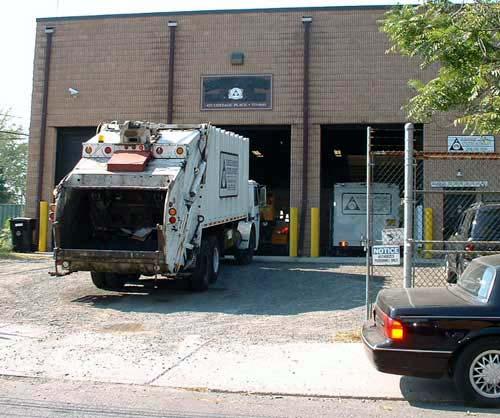
The authority has also expanded its educational outreach beyond classrooms and block associations to make sure all of the city’s many new Spanish-speaking residents understand its workings.
“People know who we are and what we are doing,” he said.
Asked what he is most proud of at this milestone, Watson said, “We‘re here and continuing to operate.”
The authority is now the city‘s fifth-largest employer, Watson said.
“Plainfield’s own people are making the city look better. They are cleaning our neighborhoods and making a living,“ he said.
--Bernice Paglia
KEYWORDS: PMUA
posted by Bernice at 9:58 AM


