Monday, August 20, 2007

Pressgrrrl vs. Bloglady

As Pressgrrrl, I spent many hours putting together a story on the NJQSAC report and other district news for the Courier. Read all about it tomorrow. Night owls can get it online by about 1 a.m.

As Bloglady I found a couple of items of interest at the City Council meeting. One will have to wait a day or so to ripen. The other is that the council intends to approve Solid Rock Construction as the contractor to fit out the 17,000-square-foot basement of Tepper’s at a cost of $459,000. That is the amount of a grant arranged by Sen. Frank Lautenberg when the space was under consideration several years ago as a senior center. The grant is due to expire soon, thus the need to commit it.

As it happened, the seniors did not want to be put in the Tepper’s basement. (Insert your own mushroom joke here.) They held out for, and got, their very own new senior center promised at 400 East Front Street, as part of the Dornoch Plainfield project with three floors of condos overhead.

The former Tepper’s department store now has three layers: 75 apartments on top, commercial at ground floor and the city-owned basement. The city took possession of the basement some time ago, but has never figured out another use for it. Possibilities have included a downtown camera surveillance center, storage, new City Council chambers or a communications center.

City Administrator Marc Dashield said Monday the contractor now will build “pretty much a vanilla box” in the basement. The administration may come back with other plans later.

The city will be liable for maintenance of the space and also for condo fees, Dashield said.

Plaintalker recently attempted to find out what the condo fees for the city are, but the information was never forthcoming. Time for another OPRA request. The city will also be responsible for around 13 percent of the condo fees for the Dornoch building, which of course won’t be known until the building is up and running.

The idea of a municipality being a condo association member just seemed weird, given the wacky stories about condo association rules. What if the city wants to put up a flag? Will there be fines and sanctions? Some suburban associations come close to fascism in their regulations. See this take on condo rules.

Anyway, the plan for the $459,000 fix-up may cover installation of air conditioning and walls, but will result in “no functional space at this time,” Dashield said.

Maybe the city is just trying to make the best of flawed plans for past years, but it’s too bad the $456,000 is not being expended on more specific intentions for the space.

--Bernice Paglia

Sunday, September 23, 2007

Tepper's Empty Box

Residents who have done battle with contractors will be interested in the city’s tale of engaging a firm to fit out the city-owned basement portion of the Tepper’s building in August. The company spent $399,842.07 of a $459,000 bid award within a month.

Tasks completed included painting at $10,439.70, electrical work at $58,650, plumbing at $74,800, carpentry at $59,800 and floor masonry preparation at $23,000.

The full list is available at the City Clerk’s office.

Major undone tasks include HVAC work at $84,084.99, with 59 percent completed.

This project was bid out because the city was about to lose a major grant dating back to when the city proposed to put a senior center in the Tepper’s basement many years ago. The grant was apparently specific to the building and not to the senior center issue, which has since been solved by the city’s deal to permit 63 condos downtown with a senior center on the ground floor.

The contractor was George Lattimore’s firm, Solid Rock Construction.

The city still has no intended use for the space.

Possibilities including new City Council chambers and downtown surveillance camera headquarters have never won approval. City Administrator Marc Dashield called the space a “pretty much a vanilla box” pending an assigned use.

--Bernice Paglia

Friday, February 27, 2009

Cameras, More to Occupy Tepper's Basement

Officials are inching closer to having closed circuit television cameras downtown, but many questions remain.

At the City Council’s special meeting on public safety Wednesday, Police Director Martin Hellwig said he wants a 24/7 operation out of the city-owned space in the basement of the former Tepper’s building. Exactly how the cameras will be monitored is still “somewhat flexible” at this time, Hellwig said in answer to Councilman Adrian Mapp’s question. Hellwig said he is looking for “partners” for the venture, possibly the Housing Authority of Plainfield, which has “passive monitoring” of its security cameras.

The camera plan has been discussed for many years, with no resolution on issues such as whether police or civilians should monitor them. Hellwig said he wants police personnel to do the monitoring.

The 17,000-square-foot space was fitted out in 2007 just as a $459,000 federal grant was about to expire. The city took possession of the basement some time ago and officials had pondered possibilities including a downtown camera surveillance center, storage, new City Council chambers or a communications center. The contractor, Solid Rock Construction, built what City Administrator Marc Dashield called “pretty much a vanilla box” in the basement.

On Wednesday, Hellwig said the Police Division’s 911 board might be moved to the space, as well as the Narcotics Bureau, which is currently in rental space on Watchung Avenue across the street from police headquarters. Moving the bureau would save $25,000 to $30,000, Hellwig said. The Community Policing unit, now in rental space on East Front Street, would also be placed in the basement.

No mention was made of the cost of putting offices and equipment in the space, but Hellwig said Public Works Director Jennifer Wenson Maier is creating a “schematic” for the interior.

The basement is one of three condos in the building. There is a 75-apartment residential portion and a separate commercial condo at street level. The city took ownership of the basement space for a token amount, but is liable for condo fees.

Hellwig said he is “project manager” for the conversion of the basement and he will be working with Jacques Howard, the city’s assistant director for community development.

--Bernice Paglia

Friday, October 05, 2007

Operation Ceasefire, Tepper's Updates

In remarks during her monthly visit to the Senior Center Tuesday, Mayor Sharon Robinson-Briggs gave an update on Operation Ceasefire.

Click here to get previous Plaintalker posts on Operation Ceasefire.

The mayor said the city is at the point of recruiting outreach workers to help the effort by canvassing the community to pass out fliers. The job will pay up to $12 an hour, she said.

Presentations on the program have been made at block associations, NAACP and Elks meetings and at churches, she said.

The target date for the program to launch was mid-2007, with the goal of reducing gun violence.

Among other topics, the mayor said she toured the recently finished Tepper’s basement space that the city owns.

“It looks very good,” she said. “It’s a very, very large space.”

The city awarded nearly half a million dollars to George Lattimore’s firm, Solid Rock Construction, to fix up the 17,000-square-foot space, which still has no identified use.

Robinson-Briggs said she is meeting with the City Council and the community to get ideas.

The federal grant money used to finish the space was about to run out in July. It was supposed to be used to put a senior center in the Tepper’s basement, but seniors rejected the plan several years ago. The former Tepper’s department store at Somerset and West Front streets was renovated with 75 apartments on its upper floors, commercial and retail uses at ground level and the city space in the basement. Each component is part of the building’s condo association.

Robinson-Briggs said possible uses for the city portion includes council meeting and office rooms, a community conference room or a main home for city block associations. She said there will be a grand openings “as soon as we do a few other things.”

--Bernice Paglia

Wednesday, February 14, 2007

PMUA Increases Rates, Reorganizes


Costs outside control of the city’s solid waste and sewer authority will cause rate increases for the first time since 2005, said presenters at Tuesday’s Plainfield Municipal Utilities Authority rate hearing.

Commissioners approved rates Tuesday (Feb. 13, 2007) that will increase some charges by 20 percent as of July 1.

Disposal fees and fringe benefits for employees are driving the increase, Bill Vukoder of T&M Associates said. Out of the $9.7 million solid waste budget for 2007, $2.8 million will go for disposal of trash. Fringe benefits have increased by 17 percent over actual figures for 2006, Vukoder said.

The annual rate hearing brought no public comment and the annual reorganization that followed brought only one quibble from a resident who felt he was being overcharged for services.

The rate changes include household increases for garbage collection from $133.02 per quarter to $159.65 starting July 1. Container fees will also increase.

Vukoder said some increases should start March 1 and the commissioners agreed. Those charges kick in when the city calls on the Authority to clean up a property that the owner fails to maintain. The hourly rate for a so-called “abatement” would increase from $216.80 per hour to $260 and the rate per ton of debris removed would increase from $155 per ton to $162.

The other increase starting March 1 would be for charges at the Rock Avenue transfer station. Residents may bring cast-offs to the transfer station for a fee, such as $2.35 per old tire. The new rate per tire would be $2.60.

The Authority is encouraging residents to recycle, because disposal fees for some recyclables are lower than those for garbage. Charges for bottles and cans will drop from $79 per ton to $34.40 and metal recycling will drop from $54 per ton to $39.30.

But garbage drop-off at the yard will increase from $86 per ton to $120.30 and bulky waste will go from $157 to $165 per ton. Vegetative waste will increase from $60 per ton to $78.50.

Sewer rates will also increase by about 20 percent July 1, to $127.25 per quarter for each dwelling unit. Fees charged by the Plainfield Area Regional Sewerage Authority account for about 30 percent of sewer costs, officials said.

Councilman Don Davis, the City Council’s liaison to the PMUA, said after the meeting the increases are “well-needed at this time” due to rising costs.

At the reorganization, commissioners chose Carol Ann Brokaw to stay on as chairwoman for 2007. William Reid will be vice-chairman, Alex Toliver will be secretary and David Beck will be treasurer for the year. Officials offered condolences to Commissioner Jo-Ann Sloan, who was absent due to the death of her father.
--Bernice Paglia

Friday, February 20, 2009

Crowd Complains at PMUA Reorg

Normally an occasion for formalities, the annual reorganization of the Plainfield Municipal Utilities Authority this year turned into an amalgam of economic woes and ratepayer dissent.

Commissioners re-elected Carol Brokaw as chairwoman, Harold Mitchell as vice chair, Alex Toliver as secretary and Dave Beck as treasurer and named official newspapers and financial institutions, among many other actions. But in the finance report, officials said the authority suffered reduced revenues and increased expenses in 2008, along with high fuel oil costs in the first three quarters, leading to a budget gap. To address the gap, the authority has made layoffs and imposed 10-day furloughs on all staff, including executives.

Details will appear in the upcoming newsletter that is sent to all city households.

The small meeting room at 127 Roosevelt Avenue was packed with residents, many from the Hillside Area Neighborhood Watch, where a movement to opt out of PMUA solid waste pickup is gathering strength. Note: Those who opt out must show proof they have contracted with a trash disposal company.

In emotional but largely civil exchanges, PMUA commissioners and executives responded to residents’ concerns about shared service charges billed even to those who opt out, perceived lack of proper legal notice for a rate hearing and surcharges for such things as putting out extra bags of trash and leaving container lids open.

The shared service charges cover downtown trash pickup as well as garbage pickup in municipal buildings and city parks, PMUA Executive Director Eric Watson said. PMUA attorney Leslie London cited state statutes that backed up the need only to provide notice of a hearing at which rate adjustments might be made. Officials conceded that some of the surcharges could be negotiated in the case of first-time mistakes.

One of the most outspoken residents was Philip Charles, who said he was concerned about the “retroactive raise in rates” and the adequacy of public notice for the Jan.22 rate hearing. Brokaw explained that the rates set that night were for the first quarter of the year and London said Charles had quoted a statute on rate hikes that referred to commercial haulers.

Charles also said he went through the complicated steps to opt out, only to be told at the end he did not do it correctly.

Resident Janet Bostic-Evans spoke about her struggle to resolve an overbilling problem by New Jersey American Water that then caused her PMUA bill to jump from $309 per quarter to $818. She said she talked to several other people with the same problem whose bills were adjusted, but hers was not. She asked why PMUA did not investigate sudden spikes in billing.

“My anger and frustration is with the staff,” she said.

Brokaw countered with her own example of a PSE&G bill that jumped from $300 to $900, which eventually got adjusted.

“I understand your frustration,” she said, asking Bostic-Evans to keep the authority abreast of her situation.

Bostic-Evans also asked whether the authority was marketing its services to other municipalities. Brokaw said the Rock Avenue transfer station had recently been expanded and the authority was marketing itself outside Plainfield, with no success so far.

‘There are some political issues, as you can imagine,” Brokaw said.

Brokaw had to bang her gavel repeatedly after Watson and resident Bob Chanda got into a heated exchange over surcharges for such things as not taking receptacles off the curb within a certain time. Chanda called the fines “penny-ante baloney” and also complained about limits on free bulk pickups, which brought an impassioned defense from Watson.

Several residents spoke more than once and exchanged phone numbers to organize future protests, some even calling for a return to private trash plans that preceded formation of the authority in 1995. But Watson said commercial haulers were suffering in the economic collapse, laying off people and also having to raise rates.

London said the authority is under the constraint of Union County waste flow rules that prevent going to the open market. All trash must be directed to the Union County Utility Authority’s disposal facility, she said. Watson noted that the PMUA had to declare a “pay to put” estimate for how much trash would be generated, but illegal dumping, both from Plainfield and out of town, has caused overages for which PMUA is charged extra per ton.

Residents told PMUA to expect a groundswell of opting out of solid waste pickup and further objections to its rates and rules. But Watson defended the authority, saying it has made the city clean. At its inception, he said, the authority held eight bulk pickups a year to cope with the pent-up trash residents had accumulated instead of paying carters to take it away.

--Bernice Paglia

Wednesday, May 13, 2009

Residents Sound Off on PMUA

A PMUA packer in my driveway.

Riled-up residents packed the Plainfield Public Library’s meeting room Tuesday to make their concerns known to two representatives of the Plainfield Municipal Utilities Authority.

The meeting was organized by the Friends of Sleepy Hollow, a neighborhood association, and moderated by its president, Tom Glynn.

The PMUA was formed about 14 years ago to handle solid waste and sewer operations in the city, but double-digit rate increases in January and what appeared to be a recent commissioners’ junket to Oakland, Calif. combined to raise the wrath of ratepayers. The Oakland event was organized by the National Forum for Black Public Administrators, whose New Jersey chapter president is former councilman Don Davis, liaison to the PMUA while in office.

The rate increases and various fines for infractions such as having garbage bags on top of trash containers led to formation of a citizens’ revolt, complete with a lawsuit and a website called “DumpPMUA.”

Philip Charles, originator of the lawsuit, told the crowd Tuesday of his ordeals in attempting to opt out of PMUA trash pickup and getting more information on the authority’s operations.

“The response has been a non-response,” Charles said.

Charles has objected to a “shared services” cost for downtown trash pickup as well as a litany of perceived excesses such as a full-color newsletter mailed to about 12,000 households and cross-country trips for conferences. Having filed multiple Open Public Records Act requests, Charles continues to amass data on the authority’s operations.

Besides Charles’ concerns, Glynn fielded questions from other residents who complained their incoming water bills somehow morphed to four times the cost for sewage disposal.

PMUA representatives Howard Smith, the operations director, and Erin Donnelly, who handles public relations, answered some questions but often directed questioners to fill out a form for future follow-up.

Pat Turner Kavanaugh, who helped organize the event, said she had asked for PMUA Director Eric Watson and Assistant Executive Director David Ervin to attend, but she said, “They fought me off.”

Referring to Donnelly and Smith, Turner Kavanaugh said, “They’ve thrown these two people to the wolves.”

As much as the two representatives tried to answer concerns, there were many more questions than could be answered on the spot. Turner Kavanaugh and others questioned the motives for a recent PMUA survey on residents' views, such as whether once-a-week pickup in winter months would be acceptable.

The PMUA issues have become a leit-motif of the current mayoral campaign, with one candidate, Carol Ann Brokaw-Boles, being the current chairperson of the authority and another candidate, Councilman Adrian Mapp, calling for “reining in” of the authority, with possible restoration to city oversight of its functions.

In addition, mayoral candidate Bob Ferraro was once a fierce opponent of the authority and then accepted a job with it, from which he just retired. The incumbent mayor, Sharon Robinson-Briggs, nominated Davis for a commissionership earlier this year, but the nomination did not come up for a City Council vote. Assemblyman Jerry Green, who along with Robinson-Briggs is seeking re-election, appeared briefly Tuesday to say he had asked the state controller to audit the authority.

Many of the candidates were attending a mayoral forum at Shiloh Baptist Church, which began at the same time as the FOSH meeting.

Although the Dump PMUA movement began during the campaign season, organizers say the group is non-political.

Though he did not appear Tuesday, Watson defended the PMUA in a recent news interview, citing problems that a city takeover would incur, including the need to assume the authority’s debt. Since beginning in 1995 with little more than a phone and a desk for Watson, the authority has established its operations base at the city-owned transfer station on Rock Avenue and has offices at other locations in the city. Initially the authority contracted for trash and recycling pickup, but now has its own fleet of trucks. It has grown to become the city’s fifth largest employer, according to Watson, with more than 100 employees.

Glynn reminded those present that the City Council will hold a special meeting on the topic of the PMUA at 8 p.m. on July 27 in Municipal Court, 325 Watchung Ave.

--Bernice Paglia

Tuesday, February 13, 2007

PMUA Meetings Tonight

The Plainfield Municipal Utilities Authority is holding its annual reorganization tonight as well as a rate hearing.

The rate hearing is 6 p.m. and the reorganization meeting is 7 p.m. at the Authority’s offices, 127 Roosevelt Ave.

The PMUA provides solid waste and sewer services to the city. It sets rates for property owners to pay for services including garbage removal, bulk waste pickup, recycling, drop-off at the Rock Avenue transfer station and sewer flow.

A little-known fact is that each flush of the toilet involves not one but three authorities. PMUA is responsible for sanitary sewer lines within the city. The Plainfield Area Regional Sewerage Authority, or PARSA, serves the city and about a dozen other municipalities. Waste ends up in a treatment plant operated by the Middlesex County Utilities Authority, or MCUA.

The sewer rates charged by PMUA thus include pass-along fees from two other authorities.

Labels:

Monday, September 12, 2005

PMUA Reaches 10th Anniversary

The Plainfield Municipal Utilities Authority's 6th Annual Environmental Fair Saturday (Sept. 17, 2005) has special meaning for authority officials. The fair, from 11 a.m. to 3 p.m. in Library Park, coincides with the authority’s 10th anniversary. Plaintalker met with officials to discuss the authority’s first decade.

Its early days were marred by lawsuits and fiscal woes, but at 10 years the Plainfield Municipal Utilities Authority is successfully carrying out its mission to keep the city clean, Executive Director Eric Watson said.

The authority was created by the city to deal with two major problems: illegal dumping and a dilapidated sewer system, Assistant Executive Director David Ervin said. The city’s Public Works Division was spending more than half its time cleaning up vacant lots and abandoned property where people were tossing trash to avoid paying garbage bills. The sewer system, built in 1913, was a marvel in its day but had clogs and leaks that needed attention to remedy chronic backups and basement flooding that plagued several neighborhoods. Municipal government, limited by tax revenues, could only do so much to address the problems. An authority is able to determine the cost of its operations and can set rates accordingly.

Ervin said the state was trying to limit the number of municipal authorities at the time that officials were trying to form the PMUA. He said former Senator Donald DiFrancesco came to Plainfield to observe one of the Public Works cleanups. When he saw hordes of rats run out of the debris, Ervin said, DiFrancesco told then-Mayor Mark Fury, “Clean up that town!“

Created in 1995 by ordinance, the PMUA began as little more than Watson equipped with a cell phone, a desk and a private van. The city extended start-up funding and the authority got most of its initial staff from Public Works. All its executives - Watson, Ervin and Louis Jones - had served as Public Works directors and were very familiar with the sewer system and the trash problems. The city and the authority signed an Interlocal Services Agreement and the first board of commissioners was appointed.

But soon the fledgling authority found itself the target of lawsuits by the City Council, citizens and trash haulers, Ervin said. The legal battle stalled its operations for two and a half years, he said.

Watson wryly recalled being named in the Courier News “People to Watch” list in 1995. But despite its rocky start and widespread suspicion by residents, the authority was finally able to start managing the city’s 116 miles of sewers in 1997. It also began a recycling program, using a contractor. In September 1997, Ervin said, the authority went out for bids to conduct citywide garbage pickup.

Soon contractors began backyard trash collection and six bulky waste pickups per year. The change from using private haulers rattled homeowners, who bombarded the authority by phone and in person with complaints.

“It was mass confusion,“ Watson said.

At first, people welcomed the chance to empty their cellars and attics of accumulated trash, making piles three and four feet high on the curbs. But later, residents tired of seeing mountains of cast-offs every other month. Some complained they were embarrassed to have out-of-town guests visit. But when the authority reduced the number of pickups, others complained they were cutting services.

The contracted garbage pickup allowed the authority to learn more about the volume of trash that needed to be collected weekly, but officials knew that when the contract ended, they would never get such a low bid again.

“We knew costs would go up and drive rates through the roof,” Ervin said.

So the authority decided to get its own staff and equipment to do the work in-house. Residents now receive two curbside trash pickups and one recycling collection each week.

Besides cutting costs, the move provided dozens of Plainfield residents with an employment opportunity. Many of the early employees had past brushes with the law or other reasons for being rejected by the job market, but with training and encouragement, a solid staff emerged.

“We’ve got a good group of guys now,” Watson said. “They like the job - they like the benefits.”

Most people are now familiar with the black-and-white PMUA logo. They see it on the shirts of workers, including those who clean up the business districts on foot; on the authority‘s fleet of trucks and specialized equipment; and on its quarterly newsletter to residents. The authority has its own administrative building at 127 Roosevelt Avenue and has other offices in several locations, including the Rock Avenue transfer station that the city owns but which the authority has improved to the tune of more than $600,000.

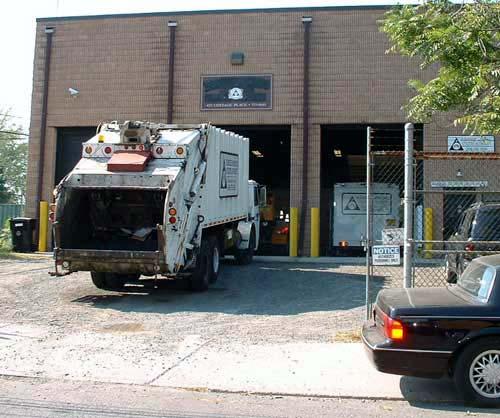
The next step, Watson said, is to renovate the transfer station to handle more tonnage and to build a complete maintenance facility for its fleet on Cottage Place, Watson said.

The authority has also expanded its educational outreach beyond classrooms and block associations to make sure all of the city’s many new Spanish-speaking residents understand its workings.

“People know who we are and what we are doing,” he said.

Asked what he is most proud of at this milestone, Watson said, “We‘re here and continuing to operate.”

The authority is now the city‘s fifth-largest employer, Watson said.

“Plainfield’s own people are making the city look better. They are cleaning our neighborhoods and making a living,“ he said.

--Bernice Paglia

KEYWORDS: PMUA